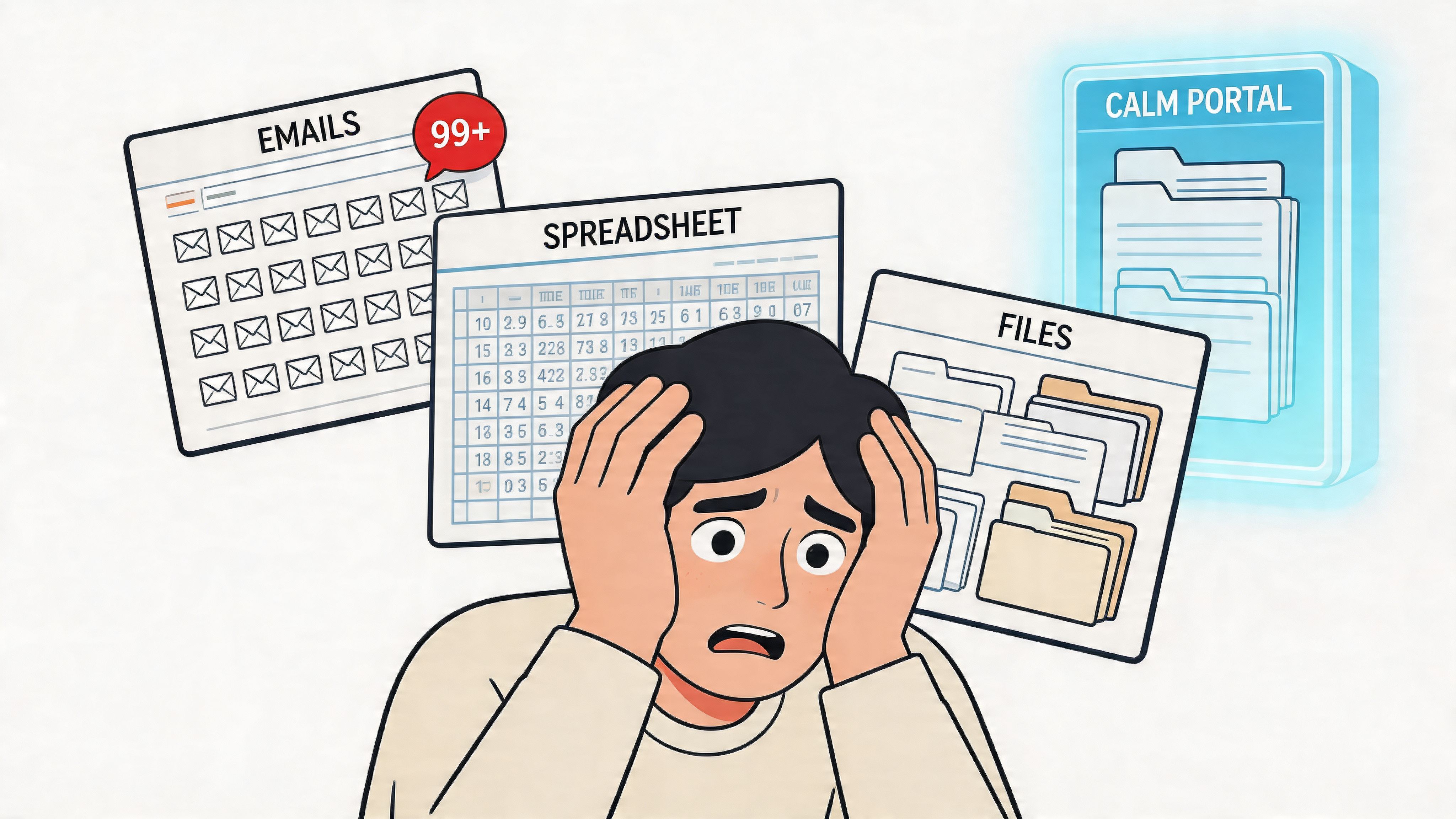
You’re probably already running a client portal. It just doesn’t look like one.
It looks like a pinned email thread, a shared Google Drive folder with vague filenames, a spreadsheet that only makes sense when you’re the one editing it, and a Monday morning ritual of sending “quick updates” that are never quick. That setup works for a while. Then one client asks for the latest proposal, another wants to know project status, and a third can’t find the invoice you sent last week. The work starts to feel smaller than the admin around it.
A free client portal fixes that by giving clients one place to log in, check updates, access files, and stop asking you for links you’ve already sent twice. You don’t need a developer for that. If you already use Notion, you can turn it into a clean client-facing portal fast, then publish it behind a proper login and custom domain so clients see a website, not your internal workspace.
That shift isn’t niche. The client portal software market is projected to grow from USD 5.8 billion in 2025 to USD 16.2 billion by 2035 at an 11.4% CAGR, according to Mak Data Insights on the global client portal software market. Businesses are moving toward self-service because it reduces friction for both sides.
A freelance designer I know had a system that looked organized from the outside. Each client had a folder. Each project had a spreadsheet. Each deliverable had an email trail. Nothing was technically missing, but everything took too long to find.
By the middle of the month, a significant problem showed up. Clients weren’t just asking for work. They were asking where the work lived, what had changed, what was approved, what still needed input, and whether the latest file was the most recent file. Every answer required context switching.
A client portal solves that by replacing scattered communication with a single destination. Instead of sending status updates manually, you maintain one dashboard. Instead of attaching files repeatedly, you publish one resource area. Instead of answering “Can you resend that?” you point clients to their portal.
A solid portal usually replaces four messy habits:
That last point matters more than most founders expect. HubSpot highlights ticket deflection rate as a key metric for customer portals. It’s the percentage of support issues resolved through self-service instead of becoming a support ticket, which is why centralizing answers and updates matters so much in practice. You can read their breakdown in this guide to customer portal SaaS tools and ticket deflection.
A portal doesn’t remove communication. It removes avoidable communication.
For a non-technical founder, the phrase “build a portal” sounds bigger than the actual work. In practice, you’re doing two simple things: